

Not all change and challenge is negative, nor is it new to anyone working in large organisations. Indeed it is, by necessity, the rollercoaster ride that all successful organisations must navigate in order to stay relevant and successful. Nevertheless it can be uncomfortable for many employees, particularly those tasked with leading their teams through challenging times.
It’s important we start by acknowledging just how tough change can be. Organisational change can sometimes feel shocking and confronting, in some cases tipping us into overwhelm. It brings to mind the example of the ‘cold wave exercise’ US marines are subjected to, by means of building up their resilience. Trainees are ordered to lie motionless on the seashore - enduring freezing temperatures, as their bodies are relentlessly battered by the ice-cold waves washing over them.
Unlike trainee Marines, we don’t have to surrender to the battering.
There is so much we can do to support ourselves during periods of intense change and challenge. It is possible to not only survive but actually thrive! Ultimately, the real beneficiaries of change are the individuals who actively embrace the process; recognising it as a path towards advancement, development and new opportunities for growth.
So, how do we take back a sense of control and tune into the potential for positive outcomes?
Here are five steps to work through:
- Acknowledge the cold shock of that initial wave
- Learn how to recover from our natural stress response
- Pay attention to how you’re feeling as ‘waves of change’ continue to wash over you
- Elevate your mood with our GONG exercise
- When you’re ready look for opportunities
Step One: Acknowledge the cold shock of that initial wave
How do you feel when you hear the phase organisational change, or restructure?
For the vast majority of people the answer is usually: risk, threat, loss, redundancies, disruption, offshoring, losing colleagues.
As humans, we have evolved to have ten times more neural circuitry for spotting potential threats than spotting potential rewards. Resulting in our subconscious brains being far more powerful at finding and imagining problems, rather than identifying opportunities. We quickly find ourselves responding strongly to the ‘perceived threat’, inhibiting both the quality of our thinking and preventing the intervention of our rational and conscious mind, to navigate through the situation.
David Rock’s renowned SCARF neuroscience research helps us identify the common triggers of stress we can all relate to:
- Status: When your positional status is changed or undermined
- Certainty: When your sense of certainty is removed
- Autonomy: When your sense of agency or choice is threatened
- Relatedness: When you feel disconnected or unsafe in your relationships
- Fairness: When you feel unfairly treated
Critically, we are talking about perceived threat. It might not be real!
Nevertheless, the physiological experience remains the same - your body will change and your rational mind will be inhibited by stress, whether the perceived threat is real or imagined.
Step Two: Learn how to Recover from our natural Stress Response
Here’s an easy guide for responding to stress in the moment - STOP – follow these steps when you begin to feel overwhelmed.
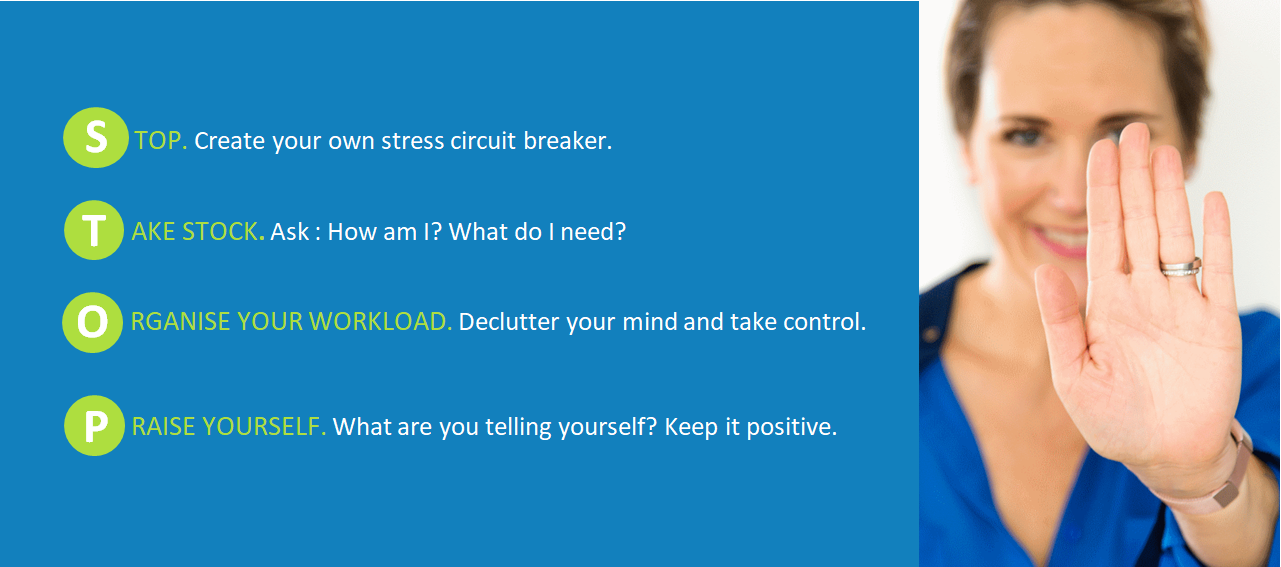
S – STOP. Breathe deeply. Go for a walk, or move away from your desk for at least 5 minutes.
However intense and crazy the firefighting feels, take a break. Re-align your brain chemistry – divert glucose and O2 to higher functioning areas. Even 5 minutes away can work like a magic wand.
T – TAKE STOCK. Ask yourself: How am I? What am I feeling? What do I need?
This is the Mindfulness bit – being self aware and supporting your own needs. Reflect on what’s going on physically, mentally, emotionally, spiritually? What can you do right now to give yourself the support you need? Often it’s something as simple as a healthy snack to balance our blood sugar levels and avoid the onset of Hangry!
O – ORGANISE YOUR WORKLOAD - Declutter your mind and take control.
Write a list or mind-map; Prioritise your work; Block out diary time for key deadlines/projects.
A stressed mind often struggles to discriminate between ‘urgent’ and ‘important’ thereby, distorting our perspective and often directing us towards ‘urgent’ items that may be unimportant. Take a step back - prioritise on importance rather than urgency. This simple step will help restore your sanity.
P – PRAISE YOURSELF. Remind yourself of your strengths and your resilience to cope.
The way we talk to ourselves is of critical importance - be your own cheerleader! Recognising what you HAVE achieved already, enables you to build on your ‘wins’ and rise to the challenge at hand.
STOP is co-authored by executive coach and wonderful resilience expert Fiona Gilkes.
Step Three: Pay attention to how you’re feeling as the waves of change continue to wash over you
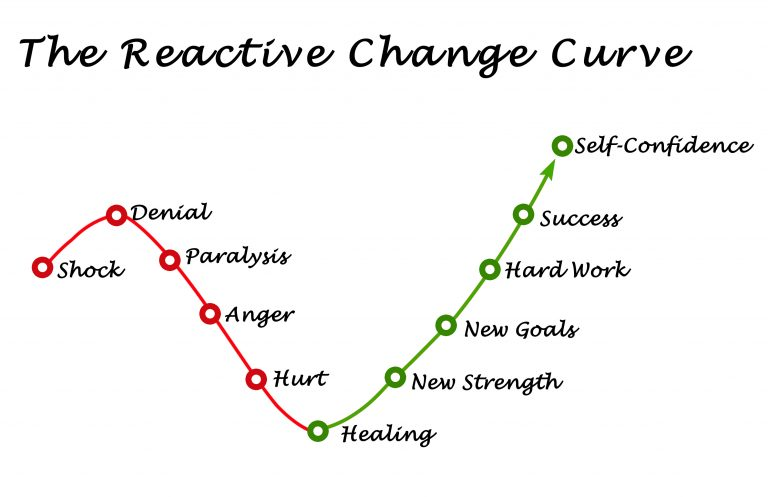
When my husband was made redundant in 2017, I stuck this simple graphic of the Kubler-Ross Change Curve onto our fridge. WHY? Because although the graph was originally devised to describe the stages of grief people pass through, following a life-changing diagnosis; Occupational Psychologists now routinely use this graph to demonstrate how individuals react to organisational change.
Kubler-Ross demonstrated that progression through the curve is not linear, but a very personal process. It's quite normal to move backwards as well as forwards along the curve, as the waves of emotion wash over you. It's useful to regularly check ‘where am I on this graph?’
It also acts as a powerful reminder to us all, that everyone needs time to adapt to change, and it’s completely normal to experience wide ranging and mixed emotions along the way. So remember -
Step Four: Elevate your mood with ‘GONG’
We’ve witnessed hundreds of people in change be hugely supported by the GONG approach: These four simple reminders help you navigate through the fog of uncertainty, fear and powerlessness and move to positive action.
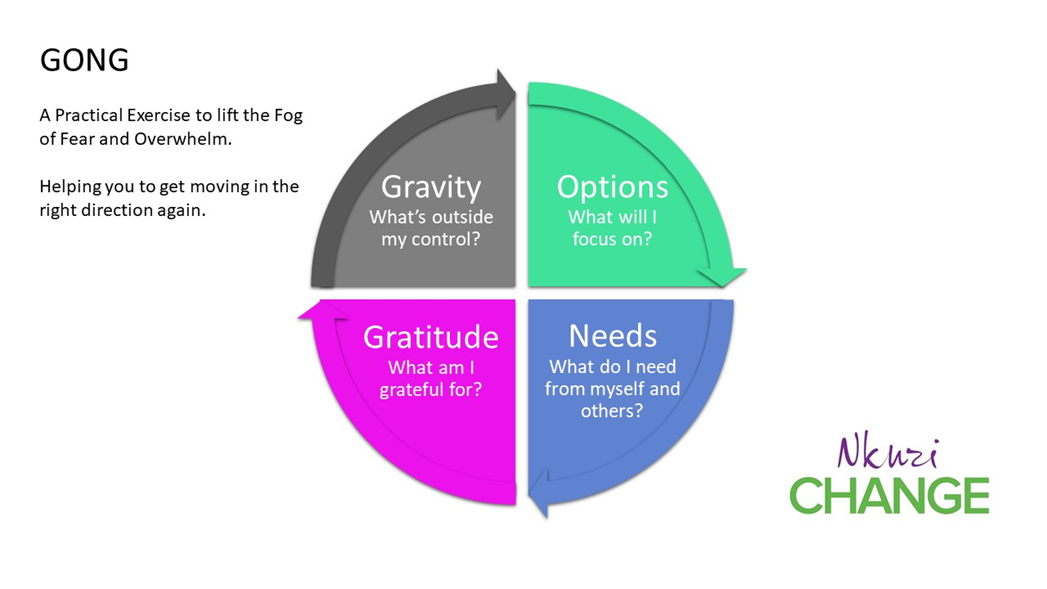
G is for Gravity
Gravity is something over which we have no control of the ultimate outcome.
It’s human nature to rail against the heavens when confronted with unwanted change; agonising over the questions of ‘why me?’ and struggling with the uncertainty and pain. However, when we adopt a more mindful approach towards acceptance, it calms the mind, allowing space and clarity to think through the next course of action.
Ask yourself a simple question: ‘What is outside my influence and control?’
Naming that which is beyond your control helps you release some of the associated stress.
There are so many issues in our lives that fit into this category; from the weather, to the economy - it’s easy to crowd our brain with negative thoughts when we watch the news. But it can also include things which hit much closer to home. Things over which we feel we have much more agency, possibly even more responsibility, things we care deeply about; but yet when totally honest with ourselves, we recognise we have no ultimate control.
For example, top of my ‘Gravity’ list right now, are my concerns about my parents catching Coronavirus. I’ve accepted I have no control over this, outside of my own actions there is absolutely nothing I can do to influence the outcome. Yet my fears around the potential outcome have hijacked my emotions, as I catastrophize about them catching it.
It’s been very useful for me to label this as an issue of gravity - thereby releasing me to focus my time and attention on the issues I can impact, rather than those I can’t.
After all, who wants to continue operating under the illusion of control anyway? It’s time to let go. Grab a pen and paper and set a timer for 5 minutes and then create a list of issues of Gravity that are clogging up your brain and hijacking your thinking.
O is for Options
In contrast to gravity, your options are the things you do have control over.
Before you start the Options List, go back briefly to look at your Gravity list.
Consider this question: ‘I don't have control, but do I have influence over this?'
Strike a line through the things on your list that you have no control nor influence over. Things like the weather, the economy are examples. Consider the remaining items on your list - issues over which you are unable to control the ultimate outcome, but you could potentially do something positive to ease the issue.
Now write your second list - Options. The purpose of this is to identify where you can intentionally choose to spend your time and attention. Take each of your remaining ‘Gravity’ items in turn (the ones without a line through them) and …
Ask yourself: ‘what positive action could I take on this topic?’
Spend five minutes scribbling down the things you can do, to mitigate against each concern.
Review the finished list consisting of all the positive things you can do.
Pick your top 3 and schedule them in your calendar as a commitment to take action.
N is for Needs
By the time you’ve finished reviewing your options, you may be fired up towards taking positive action. You now have a list of specific, positive things you can do and some priority ones you want to make a start on.
You may be tempted to jump straight into action.
First, pause and take a few moments to think about your own needs.
It's essential we take care of ourselves before trying to help others
So, let’s dig into your needs.
Ask yourself two questions:
- What do I need, to take good care of myself?
- What requests can I make of others?
These can be specific to your top 3 Options, or more generic things directed towards self-care, such as diet, sleep, exercise and mindfulness.
Pay particular attention to your answers on the second question - make direct requests to people who are sharing this journey with you. During periods of overwhelm, it’s very easy to isolate ourselves, feeling the need to solve everything ourselves. It's vitally important to ask yourselves this question. Help comes in many shapes and sizes – asking friends to listen, arranging extra childcare to get some thinking time or asking a partner for any guidance/help they can offer.
Spend five minutes creating your 3rd list around your Needs.
The Final G is for Gratitude
Gratitude is the most powerful part of GONG: The benefits are immediate and enormous.
Recognising what we have to be thankful for, even during the worst of times, fosters resilience because gratitude focuses on what we have, rather than what is lost or missing.
When my husband was made redundant, it was powerful for both of us to keep noticing the things we were grateful for: He had a great reputation in his field and lots of people offering to help him, we had a lot of financial security that made it very unlikely we’d have to move home, and I had a career that I loved. Continuing to pay attention to those anchors felt very reassuring during the most unsettling moments of the change.
Take 5 minutes on your final list.
Again, I want you to ask yourself 2 questions:
- What am I grateful for?
- What am I grateful to myself for?
The first question is more obvious than the second. We’re familiar with being asked to make time to notice what we’re grateful for.
But when have you ever stopped to recognise your own worth in this way? In asking yourself ‘what am I grateful to myself for?’ I’d like you to tune into the contributions you've made, that are already having a positive effect.
Step Five: When you’re ready, look for the opportunities.
Once you’ve identified the initial cold shock wave of change, worked through the exercises, and started the recovery process - you will feel calmer and able to begin exploring new possibilities.
Kick start a more positive exploration of the change you are facing - ask the following:-
- What positives could emerge from this change?
- For you, for your colleagues, for the organisation, for your customers?
- What new things could you learn?
- How might this benefit your CV and/or employability and/or transferable skills?
- What do these changes demand of you, in terms of skills and mindsets?
- How might you develop these skills and mindsets?
- Who could potentially help you with this growth?
- How could your existing strengths and experiences be relevant to this change?
- How can you offer those strengths and experiences?
- How do you want to support the change effort?
- Who else is experiencing ‘challenge’ right now and how could you support them?
Change and challenge feel at best uncomfortable and sometimes overwhelming
But they are a permanent fixture in this ever-changing, evolving and wonderful world. Knowing there are strategies and tools to help us ride the waves, rather than disappear beneath them, is both reassuring and empowering. Recognising change as a potential opportunity isn’t always easy, so use these tools to help navigate through it, but above all else, be kind to yourself and those around you.
Although often difficult, change can also be very rewarding and liberating.
I’d love to hear your thoughts on navigating stress and building resilience. If you would like to pick up this conversation I’d love to hear from you.
At Nkuzi Change our mission is to help organisations unlock the full potential of their people through coaching and we specialise in issues of change and challenge.
Reach me on email at
And connect with me on LinkedIn