

Coronavirus has changed our worlds, personally and professionally.
Some aspects of our lives have been put on pause and we’ve had our eyes opened to the fact that how we chose to behave, even in the simplest of everyday gestures, has a profound effect on others. There’s recognition that going ‘back’ isn’t an option, we need to radically evolve our beliefs and behaviours, to make sure we haven’t missed the point of this pandemic and that we’ve learnt some serious lessons.
Now, more than ever, people all over the world are turning to their leaders for guidance, answers and the path forward out of this crisis.
So, what are we seeing?
Poor leadership has resulted in the deaths of tens of thousands of people and now as we start to see light at the end of the tunnel in the form of the vaccine, we’re faced with an uncertain economic future that will undoubtedly affect tens of thousands more, over many years to come.
There is a universal cry for people in any position of leadership to act in a way which restores confidence, motivation and belief in everyone who looks to them for direction, guidance and inspiration.
My current thoughts on leadership brought me back to an earlier stage of my career when I took my first leadership position in the corporate world. I was super aware of the responsibility this brought as I’d worked with leaders who had a profound effect on my life, both positive and negative.
I became fascinated with the subject of leadership, I read books, listened to podcasts and practiced countless different approaches some of which worked better than others (apologies to my earlier teams)! Over time I found that there wasn’t one single approach that would serve the needs of every team. This was true even in the brilliant leaders I looked up to, they all had different approaches, but what they had in common is that they all demonstrated what I now call ‘The 5 Cs of Leadership’.
Over the years I’ve developed my own leadership style through which I sought to include these elements. But we’re all ‘work in progress’ and now as a business coach I help my clients with their own leadership formulas – and they find my 5 C’s model helpful, so I’m delighted to share it with you too.
I’ve already made and shared several videos on these 5 Cs of leadership and I've embedded them here, I hope this summary will help us continue the conversation about what good leadership looks like in our new world.
The 5Cs of Leadership
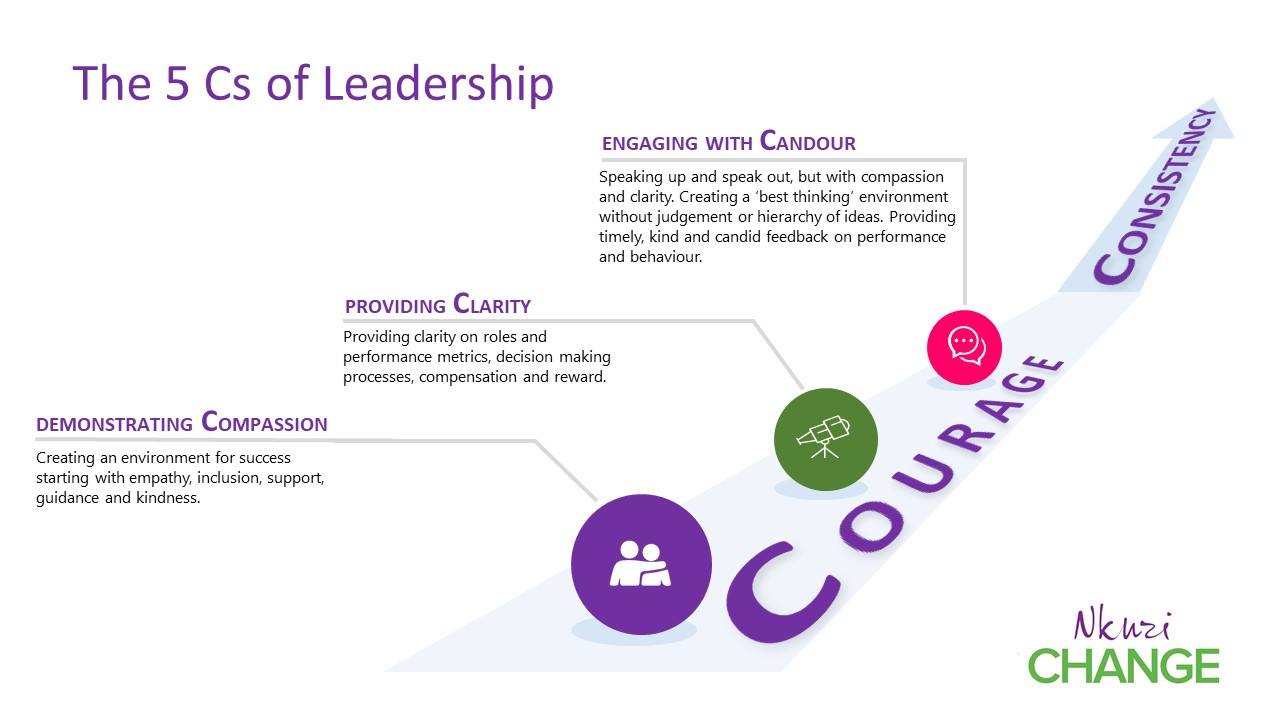 1. The first C is for Compassion See the video
‘I refuse to believe that you cannot be both compassionate and strong’ Jacinda Ardern
This is the first and most important C in my 5 Cs of Leadership model.
I see 3 keys to ensuring you’re leading with compassion;
Connection - Are you taking the time to put yourself in the shoes of the people that you’re leading so that you can meet them where they are and truly empathise with them? Do you know what matters to them and why? If not, how are you expecting to motivate and lead them to success?
Authenticity - Creating this connection requires authenticity on your part, you must role model the type of vulnerability that you wish to see in your team. Present yourself as you are, allow yourself to use vulnerability to create a ‘safe’ work environment of mutual trust. This helps your team in being comfortable in expressing their creativity and presenting their diversity of thinking because they know that they can be themselves.
Kindness - Leading with kindness does not make us weak, it makes us strong, individually and collectively. The most successful leaders treat their team members with kindness. They realise that kindness is motivating, earns the trust and respect of their people, and leads to better results.
2. The second C is for Clarity See the video
Brené Brown says - ‘to be Clear is kind, to be unclear is unkind’
With the Covid crisis we've seen plenty of evidence (particularly from some world leaders) of the chaos created by muddied, muddled and vague communication, I can only imagine the scale of damage that has been created by poor communication in organisations across the world.
I’m sure most leaders would say they need clarity from their team, but how many role model clarity in their leadership?
Check your language and avoid ambiguity. If working hours are now ‘flexible’ be specific about what this means. Give explicit autonomy wherever you can. And establish a reliable, open communications pattern, regular encouragement to ask and answer questions builds a habit of clarity within your team.
Finally, clarity is aided by repetition - the rule of 7 tells us it’s simply not enough to be clear, we also need to repeat, repeat, repeat.
3. The third C is for Candour See the video
I’m sure most of us would agree that we need an unimpeded flow of information in order to make good decisions and this is why Candour is a crucial pillar in leadership. This is the opposite of some authoritative leaders who hoard information which leads to a breakdown in trust and is contagious - if you want candour you must offer it first.
This isn’t always easy. The pursuit of candour means giving and receiving unwelcome information, something that requires courage - more on this later!
I thought I’d ‘nailed it’ when I came up with the first 3Cs – but the more I reflected on this and worked with these principles with my clients, I realised there was more. There are 2 more Cs that act as a foundation to the first 3Cs and that without these we couldn’t fully explore what was possible with Compassion, Clarity and Candour.
4. The fourth C is for Courage See the video
I've often thought that I should have Courage tattooed on the back of my hand because I've needed it so often in my many leadership roles! Yet finding enduring courage has been one of the hardest of my leadership lessons.
Courage is the cornerstone of the first 3 Cs:
- You need courage to role model Compassion (the 1st C of Leadership) because that courage allows you to be vulnerable.
- You need courage in the pursuit of Clarity (the 2nd C of Leadership) because this can often mean receiving or delivering difficult messages.
- You need courage for candour (the 3rd C of Leadership) because making decisions and being open and honest about them to the people who may be the most affected can be really hard.
You also need courage to admit that you don’t always know what you think you ‘should’. Letting go of the expectation of being right and knowing more than others, requires courage.
5. The fifth C is for Consistency See the video
This final C is Consistency. Consistent people are solid, reliable and predictable. They don’t change the rules of the game dependent on their mood - or the last conversation they had. You can count on these people to treat everyone with respect, irrespective of hierarchy or authority.
Consistency doesn’t just mean showing up, it means keeping and delivering on promises, ‘walking the talk’ of being trustworthy. Combined with courage, consistency helps us choose a leadership style that demonstrates we’re not just capable of doing the ‘right thing’ rather than the ‘easy thing’ occasionally, it helps us do that every day.
Some of these traits or behaviours have been traditionally viewed as nice to have qualities, but in this unprecedented time, I think they are critical for leaders as we face continued change and challenge. I believe this type of leadership won’t only be required at the top of the organisational chart but at every level of human interaction.
But maybe I don’t actually have this leadership model ‘nailed’ yet. Maybe there are other leadership traits that are emerging as critical in your world?
I’d love to hear your thoughts, so if you would like to pick up this conversation, or for more information on leadership, harnessing strengths, and managing through times of challenge and challenge, I’d love to hear from you.
At Nkuzi Change our mission is to help organisations unlock the full potential of their people through coaching and we specialise in issues faced by Middle Leaders in large organisations.
Reach me on email at elise.finn@nkuzichange.com
And connect with me on LinkedIn