

5 mistakes you’re probably making leading change in a big company … And what you can do to course correct.
This article is for you if you’re …
- An ambitious leader in a big business who is driving a difficult change agenda
- A Leader in HR, talent and L&D who want to understand what’s happening in their business that makes successful change so elusive
Everyone knows that every business must adapt to thrive and even to survive.
But real, meaningful and lasting change is so elusive for big businesses. There are endless stories of failed business change agendas, and McKinsey cites a 70% failure rate for change programmes.
Yet change IS the ONE thing businesses must do, especially big businesses.
McKinsey says the average lifespan of companies listed in Standard & Poor’s 500 was 61 years in 1958. Today, it is less than 18 years. This means the majority of large companies will disappear (at least in their current form) in the next decade.
Change comes in many guises and in large companies this often means consolidation as big businesses continue to grow through acquisition. It’s very common to find yourself part of a ‘deal team’ if you’re a senior lead in a large organisation – and having to manage all of the pressures this brings alongside your day job.
If you’re a senior leader in an organisation that has recently been bought or is acquiring, there is important work to be done in helping people adjust to the new normal. When this is ignored, people make up their own version of what the change means, frequently seeing threats not opportunities. Without the right support, it’s common for major change like this to be viewed negatively by those who are most important to making it a success.
Another type of change programme that’s common in big businesses centres around company culture, often focused on embedding company values and behaviours. As companies adjust to the world post pandemic there is a greater emphasis on developing sustainable, intentional cultures that provide a foundation of how we act and interact with each other - whether we’re fully remote, back in the office full time or pursuing a hybrid way of working.
Most big companies recognise the importance of defining common values and modelling desired behaviours, but it’s notoriously hard to bring these to life and embed them with consistency.
So, there are many different types of change happening and if you’re working in a big organisation you will be a part of this change even if you’re not leading it.
If you’re spearheading all or part of a change programme, this will be both exciting and uncomfortable. You may be aware that your personal reputation is on the line.
Driving change is hard, we know the stats tell us most change programmes fail to deliver the intended benefits and results they promised.
There are many reasons for this rate of failure – some outside of our control. In this article we focus on what we can control. We outline the 5 mistakes we see senior leaders making in driving change, many of which we’ve made ourselves.
If you recognise any of these mistakes, don’t despair.
Awareness has to come before choice, so becoming aware of the mistake is the first vital step, then we can choose to course correct. We offer plenty of practical advice you can start working with today if you realise you’re stepping into one of these danger zones.
Mistake Number 1. You’re looking up, not in
This mistake is all about where we put our attention. It’s very common to overinvest attention in senior leaders and the C-suite and ignore the power of Middle Leaders.
If you’re leading a significant change, you’ll have been involved in senior level discussions about the need and design of the change for some time. To secure Board and Exec level commitment and budget, you’ve worked behind the scenes with the senior team for months. You’ve worked hard on building the case for change, creating deep belief in why the change is necessary and the benefits it will bring.
Looking up not in, is such an understandable and common mistake. The reporting cycle of big change projects means we need to look up on a regular basis. Big change agendas get a LOT of scrutiny – weekly reporting, key KPIs, risk radars, traffic light reports – we know how to turn up the heat on those leading change agendas and we demand a lot of them.
Until now, your focus has rightly been at the top of the organisation, on the people who will green light the change. But that focus needs to consciously shift.
When we move from planning change to leading change, we must shift focus from the people who will fund and resource the change, to the ones who will actually make it happen.
This is about engaging the people who will make the change happen EARLY. It’s never too early. Because once we move into making the change happen it’s no longer about the people at the top. It’s about the people who understand how the business works today, so they can co-create the change implementation plan. And those people are your Middle Leaders.
Middle Leaders are the people who make the difference between successful and failed change. They can be the Resistors or the Change Agents.
If they aren’t fully bought into the need for the change and clearly understand their part in making it happen, Middle Leaders are very effective at ensuring it never gets off the starting blocks. This is why they are so often referred to as the ‘Frozen Middle’. Without their active and ongoing support, the work required to make the change real simply won’t happen. Their influence matters because the vast majority of people in the organisation report into a Middle Leader – so how they feel about the change programme will be viral within their team. Collectively this means Middle Leaders influence how people feel about the change all the way across the business.
So, what’s the antidote to this mistake?
- Ensure all decision makers and influencers who are working on the change are well educated about the importance of Middle Leaders in making change happen.
- Intentionally shift attention to the those in the Middle
- Engage early and often, explain, host debate, invite emotion and actively stimulate opinion
- Make yourself available as an ally to those in the Middle – your job in leading change must become about supporting them, rather than having the authority and the answers
Mistake Number 2. You’re 'cascading' not communicating
Effective and consistent communication is critical during times of change. This is widely recognised, so big company change initiatives are usually supported by detailed communications plans – with an emphasis on information and consistency. It’s typical to see comms plans that include what appears to be a good and thorough mix of Town Halls, briefings, lengthy decks and line manager briefing packs.
Cascaded information is better than a complete lack of information – so it’s a good first step. But without a plan for creating two-way conversation, this cascade will achieve little actual change. Knowledge is not the same as action.
If change information is only delivered via a one-way cascade, it’s not real communication. It will do nothing to create genuine engagement in the people who are critical to bringing the change to life.
In big companies, it’s Middle Leaders who are critical to delivering the message of change to the vast majority of the workforce. They are the ones who their team members look to for dialogue. When it’s done well, change communication is MOSTLY happening at team leader level. Team leaders are potentially the best placed to build awareness of the need for change, to get buy in to the effort the change brings. Critically, it’s the team leaders who are potentially best placed to explore the barriers to change with those who understand them.
Yet we consistently fail to engage Middle Leaders properly and meaningfully – they just get the cascade from above. Anything that falls on our head from above with little or no warning or context, automatically makes us flinch, and for good reason.
Engaging Middle Leaders early is critical to their understanding and buy in. Often they only hear the news of a big change a fraction of time ahead of their teams. This means they don’t have a chance to absorb the news for themselves, and with an absence of conversation, their questions often remain unanswered. And yet they are expected to communicate the news to their team, who will be looking to them for what this change means for them. This is a very difficult situation to put people in, so it’s not surprising they often abdicate responsibility. Without the right support, team leaders will frequently pass on the cascade with minimal attention, just forwarding the comms to ‘check the cascade box’ without any ownership.
When the quality of communication drops to this bare minimum, there is little chance of real engagement or positivity about the change. The people who are relied on to bring the change to life will be disinterested at best, and may become real blockers for change, especially if they feel threatened by it. McKinsey research demonstrates how critical this factor is to the success of change: Their recent evidence shows that the standard 30% change programme success rate diminishes to just 3% when Line Managers are not engaged.1
So, what’s the antidote?
- Ban the term ‘cascade’ from your vocabulary and replace it with ‘engage’ – just owning this shift and asking yourself and those around you, how you could make this shift in everything you do, will make a material change to the way you design your communications.
- Don’t fool yourself that communication only needs to happen once. We need to hear things about 7 times before we really register what we’re hearing – especially if the news is big and new. And the first emotions we usually feel when we are surprised by unwelcome news is shock and denial – as our brain struggles to adapt to new information we find ways to make it ‘not true’ as a natural coping response. Remember how you felt when you heard about the first Covid lockdown? Most of us experienced denial as our brains tried to process something that was so new and unbelievable to us.
- Make every effort you can to have a conversation rather than a broadcast. Get curious about what people are feeling (more on this later). What are they assuming? What do they want to ask, but can’t find a way of expressing?
- Meet people where they are and take time to explain why the change matters. You will have had months or longer to adjust to the idea of the change – and you’ve likely been involved in the design of the change plan. To build the same excitement about the future the change offers among middle leaders, its critical to meet them where they are – and to slow down, be patient, and allow time for the adjustment.
- Use multiple channels for people to ask questions and voice concerns. Don’t simply revert to Menti for Town Hall questions. Anonymous forums have a place, but they are not a replacement for conversation. When used as a single channel, they encourage keyboard warriors who feed fear and disengagement.
Mistake Number 3. You’ve failed to 'clear the decks'
Senior leaders must be more focused on strategy than on today’s productivity and performance.
The more senior you become, the further away you get from the coal face of operational delivery. This is an observation not a criticism – but it does mean it’s easy for senior leaders to undervalue business as usual (BAU) work.
We need people to run the business, change the business and plan the business – these are all important roles. But if the change leader is completely focused on the change, it’s easy to overlook the importance of the current, everyday work of running the operation.
As a result, there’s a common mistake at implementation stage that blocks successful change: Operational leaders are expected to just pick up the extra work on top of their existing BAU priorities.
When we layer change on top of the existing work of running the business, without careful thought and debate about the implications, we are setting ourselves up for failure. Even worse, when those stressed ops leaders express doubts about their capacity to deliver it all, they are often dismissed as ‘change resistant’.
This is a mistake I’ve made many times – here’s the lesson that comes to mind.
Elise – Co-Director Nkuzi Change.
Early in my career, I was running two call centres, with around 500 people in each. An acquisition led to merging the acquired company’s call centre into ours, which made sense as we had room for expansion and had experienced staff.
The mistake I made was not thinking enough about what this would mean for our call centre supervisors and team leaders. They were expected to pick up all the extra training and onboarding, whilst managing through the challenge of change and uncertainty and delivering to the same performance expectations as before. Instead of adjusting our expectations, lowering targets on our usual suite of KPIs and warning customers and stakeholders of the disruption, and possibly giving them some alternative ways of solving their queries, we just ‘pushed through’.
We knew our service levels would be compromised - but we didn’t own that or plan for it. This would have taken a little more time, but we would have got a better outcome if we’d made time to talk through how we would handle the change.
As a result, we had chaos and a lot of burnout in the operation that took us a long time to recover from. Yes, we implemented the change. But the outcome wasn’t a good one. Because we had failed to ‘clear the decks’ for the change to happen. We just tried (and failed) to incorporate it into BAU.
So, what’s the antidote?
- Change is not BAU - so let’s not treat it like that. The implementation of change needs oxygen to grow, and not just from the top. Recognise this and talk to the people who are delivering operational results. Encourage debate about how to manage the impact of the extra work and which stakeholders need to be communicated with.
- Debate what you can afford to ‘let go of’ so they can prioritise the work the change will bring.
- Help people to own what the new ‘good’ looks like and talk about how long this transition period is likely to last. Don’t underestimate how hard this can be for operations – if you usually spend your working life watching key operational KPIs it can be hard to take your eye off them for a period and still feel good about the result.
- Keep talking, this isn’t one conversation. It needs to be an ongoing debate and the operational teams need to be an active part of the flagging and problem-solving process – they can only do this when they are part of the conversation.
Mistake Number 4. You’re avoiding the 'F' word
Do feelings have a place at work? Feelings are messy, can be embarrassing and of course, feel intensely personal.
Yet feelings get to the heart of what it means to be human – and we need our humanity at work as much as we need it anywhere in our lives. And feelings have a direct link to impact.
Our emotions play a very important part in our ability to focus, perform and to embrace change.
Feelings are part of a cycle that drives our beliefs, our behaviours, our actions and therefore our impact.
We’re good at talking about impact at work: KPIs, goals, objectives, OKRs – this is the language of impact – but track impact back and our feelings play a big part in the impact we create.
Whether we openly discuss feelings or not, they are highly contagious. Fear breeds fear. Similarly, optimism is catching. We all know this because we experience it every day.
We all experience a range of emotions in response to change and this is well illustrated by the Kubler- Ross Change Curve.
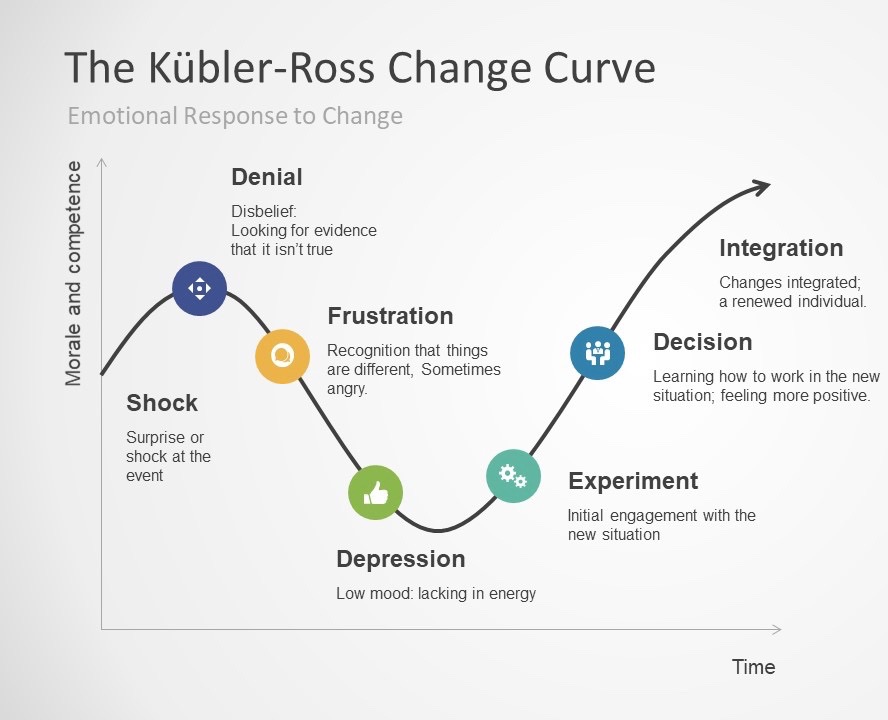
The curve starts with shock and denial. Then we typically move onto feeling something like frustration, anger and maybe even depression. When we’re experiencing these emotions our productivity plummets – our ability to focus, concentrate and problem solve is compromised. We can become easily distracted and prone to making uncharacteristic mistakes.
Eventually we start to recover and move towards bargaining, problem solving and acceptance.
Everyone moves through the curve at different rates and it’s not linear, it’s not a step-by-step process. I might be feeling angry today but could slip back into denial tomorrow. It’s a bit like a rollercoaster without a fixed track that can move in any direction at speed.
We can’t predict how long we’ll stay in each stage or how each person will move through the curve, BUT the research clearly tells us we will all experience these emotions when we’re faced with significant change.
When we repress our feelings – deny them or push them to one side, they don’t disappear, they still need to be worked through. And when we deny them, that process takes longer.
So, as uncomfortable as it might seem, it makes good commercial sense to pay attention to feelings, especially during times of change and challenge, as this is when we want and need to be at our best and to do our best thinking.
So, what’s the antidote?
- Recognise we all need to process our emotions to move through change successfully and return to doing our best work.
- Educate yourself around the Emotional Change Curve, understand how it works so you can spot the signs in yourself and others.
- Make space for the conversation around ‘how are you feeling?’ Listen to people’s responses without holding on to the need to have all the answers or to solve everyone’s concerns and challenges. Sometimes, all we need is to share how we feel in a non-judgemental space, so we can move on successfully.
- Share how you’re feeling. Role modelling vulnerability is a powerful way to build trust and as a leader you must be prepared to do anything you are asking of others. This gives people permission to pause and think about how they are feeling and the impact this could be having on the people around them.
Mistake Number 5. You’re leaving the others behind
The final common mistake in big company change programmes is often driven by the need to provide evidence of progress and success. Ironically, the faster we move, the more likely we are to move towards failure and not success.
Because meaningful and lasting change in a big company is achieved with and through others. If those ‘others’ aren’t on our bus, or if we’re leaving them behind, we’ll move fast – towards failure.
Change leaders are typically selected for the change role because they are highly driven and have a reputation for getting things done. Those are valuable strengths, but they can become de-railing when overused. Why? Because they often have a shadow of impatience and wanting to ‘just get on with it’ – alone, and at all costs.
Stopping to communicate, to involve and engage others can feel like a waste of time. This case study is a great illustration of this.
This is a mistake close to my heart as it was the genesis of a nickname it took me a decade to shake off.
Elise – Co-Director Nkuzi Change.
Almost 2 decades ago I was in a workshop with some of my senior stakeholders and as part of a leadership development exercise we were working in pairs with someone we worked with, not for – a peer who knew us well.
The assignment was to use a creative metaphor to describe the leadership style of the person we were paired with and to elaborate on the pros and cons of their style. I was paired with an incredibly smart lady called Susan who was about to deliver one of the most impactful pieces of feedback of my early career.
She said something like “Elise you’re a bullet train. You know where you’re going and you’re getting there super-fast and ultra efficiently. For the people on board your train it can be a wonderful experience as they feel part of a winning team”
At this point I was starting to feel rather smug. But Susan continued …
“But there is only room for a few hand-picked passengers as you see people as a weight that slows you down.” I started to feel a little uncomfortable at this. Susan went on to say …
“And my goodness, no-one wants to be standing on a platform when you pass by, as you’re not slowing down for anyone, the experience takes your breath away and not in a good way.”
This stung.
With this brilliant and painful metaphor, Susan had described how my sense of purpose and need for single handed progress, made people feel they didn’t matter and that I had no time for them. My need for speed was at the cost of those around me, and ultimately this was creating a poor reputation for me as a leader and a horrible experience for those who didn’t have a designated place on my train.
In big organisations, lasting, meaningful change doesn’t happen because one person pushed it through at the expense of others. It happens when we move together to co-create an outcome we can all value and all see our contribution to.
“If you want to go fast go alone. If you want to go far, go together”
Burkina Faso proverb
So, what’s the antidote?
- Recognise that everything meaningful in a big company is achieved by a team and not an individual. That team needs to bring the company along with them, otherwise they are mavericks whose need for speed will become their derailer.
- This means we must stop trying to do everything yourself by forcing things through. Develop your patience and keep reminding yourself of the value of moving together.
- Become much more aware of the impact you are creating for those around you. Keep asking for feedback and listen without judgement to the wisdom people offer you, however hard it is to hear. One practice I adopted as a result of Susan’s feedback was to always end 121 meetings with 2 questions ‘what do you want me to do more of?’ and ‘what do you want me to stop doing?’
- Ensure you are creating the conditions for people to be open with you about their concerns and challenges. Work hard to build trust and encourage people to speak up.
- This does not mean you must accept a much slower pace. But it does mean you need to be aware of how many people you are losing because you’re moving quickly. Remember awareness comes before choice, if you choose to move fast, understand the price you will pay in losing people along the way. If your change is relatively small maybe you can move fast, but any big strategic change agenda needs relies on a lot of people buying into and making the change possible. In this case chose speed over engagement at your peril.
We’ve many examples of where we’ve seen these 5 mistakes in action. We also have evidence on our work in successfully overcoming them, and creating measurable change with our clients in as little as six short months.
If you’re a leader in a large organisation and recognise some of these challenges, you don’t need to be stuck on how to tackle them. As a first step, recognising and addressing these challenges becomes the enabler for positive change.
At Nkuzi Change we unlock potential in big businesses. We have a proven methodology for creating measurable behaviour change in individuals and teams in a MATTER OF MONTHS. We can make the difference between your change agenda succeeding or failing.
If you’d like a conversation with us about accelerating successful change in your business, please get in touch.
About the Authors
We are Elise Finn and Kate Franklin, co-Founders and co-Directors of Nkuzi Change.
Over the past 2 years we’ve studied this topic up close. We’ve run over 20 scaled Leadership Programmes with 7 different, large, global B2B businesses. We’ve worked with more than 400 Leaders in those businesses and spent 3000+ hours coaching these leaders on how to lead successful change. We also have the real lived experience of leading change in big businesses. We’ve lived it. We’ve been at the coal face and led change agendas from the C suite.